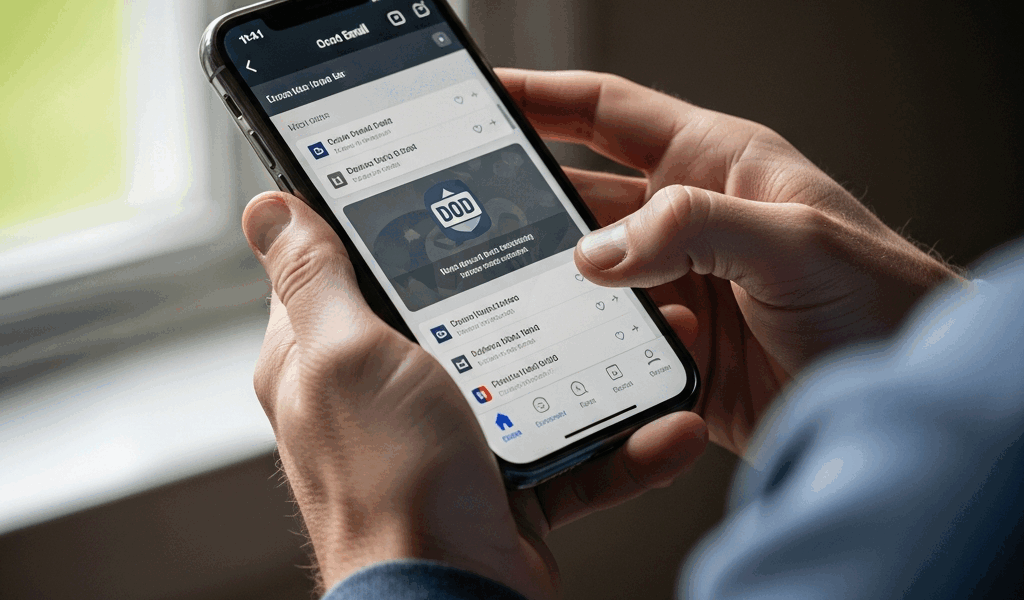
How to Access DoD Email on Your Personal Phone in 2026
DoD email access on a personal phone has gotten complicated with all the conflicting advice flying around — half of it outdated, a quarter of it just wrong. This guide exists so you don’t repeat that.
The short answer: yes, it works. Your personal iPhone or Android can pull .mil email without a government-furnished device. Here’s exactly how.
Can You Actually Access DoD Email on a Personal Phone?
Yes. Full stop. This stopped being a gray area a while ago.
But what is a derived credential? In essence, it’s a cryptographic copy of the certificates stored on your CAC — tied to your identity — that lives on your phone instead of the physical card. But it’s much more than that. It’s the entire foundation that makes mobile DoD authentication work without carrying a card reader everywhere.
Your CAC holds certificates that prove who you are. Normally those certificates are trapped on the physical card, which is why you need a reader to log into most DoD systems. Purebred — a DISA-developed app — extracts those credentials and installs them directly onto your device. Once that’s done, apps like Microsoft Outlook can use those certificates to authenticate against DoD mail servers: the Outlook Web Access endpoints under mail.mil and the newer Microsoft 365 DoD cloud environment.
Legitimate. Authorized. Specifically designed for unclassified email access on mobile devices. The program has been running since around 2018 and covers both iOS and Android as of 2026 — personally owned devices included, though some installations will push an MDM profile onto your phone as part of the deal. More on that below.
One thing worth saying upfront: this gets you unclassified .mil email. That’s the scope. Not NIPRNet desktops, not SharePoint in most cases, nothing classified. The access is real — just not unlimited.
iPhone Setup — Step by Step
Frustrated by a deployment where checking suspenses meant hunting down a terminal, I finally did this properly using my personal iPhone 15 Pro running iOS 17 at the time — though the process is essentially identical on iOS 18. Here’s what it actually takes.
Step 1 — Get Your Purebred Registration Code
You can’t just download Purebred and start. A Purebred registrar at your installation — usually an S6, G6, or J6 tech, sometimes a designated identity management office — has to issue a one-time registration code tied to your EDIPI. That’s the 10-digit number on the back of your CAC. Go in person. Bring the card.
Some installations have a self-service kiosk for this. Most don’t. Budget 30 to 45 minutes, not because it takes that long but because there’s usually a line or a callback situation involved.
Step 2 — Download Purebred from the App Store
Search “Purebred” in the App Store. Developer is listed as Defense Information Systems Agency — DISA. Free download. Current version as of early 2026 is 3.x. Download it before your registrar appointment if you want to move faster. Some registrars will walk through enrollment with you on the spot, which cuts the total time significantly.
Step 3 — Enroll and Install Certificates
Open Purebred, drop in your registration code, follow the prompts. The app will ask permission to install configuration profiles — allow it. This is where derived credentials get pushed into your device’s keychain. Takes about five minutes when it works cleanly. You’ll end up with multiple certificates: authentication and encryption, both tied to your identity.
After enrollment, go to Settings > General > VPN & Device Management. A DoD configuration profile should be listed there. If it’s not — enrollment didn’t complete. Back to your registrar.
Step 4 — Configure Outlook for iOS
Download Microsoft Outlook from the App Store, open it, add a new account using your full .mil address. Authentication will redirect to a DoD login page — this is where the certificates activate. iOS will offer your installed client certificate. Select it.
Server settings, depending on your organization:
- Exchange server: webmail.apps.mil for most O365 DoD tenants, or outlook.office365.us
- Domain: leave blank, or use your org’s domain if it gets prompted
- Account type: Office 365 or Exchange, depending on what appears
If your command hasn’t migrated off legacy Exchange yet — some haven’t, honestly — the server address will be different. Your S6 has it.
Step 5 — MDM Enrollment (If Required)
Some installations require MDM enrollment before allowing personal devices to pull mail. On iPhone this usually means installing a management profile from Microsoft Intune or MobileIron. Your command gets limited compliance visibility — whether your device is encrypted, whether you have a passcode set. They cannot see personal photos or apps. That part is worth saying clearly because it’s where most people get nervous and bail on the whole process.
Don’t make my mistake — I avoided this step for six months based on vague concerns about privacy, only to find out the actual MDM scope was narrow and pretty reasonable. That said, if MDM is a genuine dealbreaker, there’s a workaround: access webmail through Safari at mail.mil or webmail.apps.mil, using your Purebred certificates to authenticate. Slower. No MDM required.
Android Setup — Step by Step
Android is similar in concept but different enough in execution to deserve its own section. I’ve run through this on a Samsung Galaxy S24 and a Google Pixel 8 — the experience varies more across Android devices than it ever does across iPhones, mostly because certificate management isn’t standardized the way Apple’s keychain is.
Step 1 — Get Your Registration Code
Same process as iPhone. In person, CAC in hand, S6 or identity management office. No workarounds here.
Step 2 — Download Purebred from Google Play
Same developer — DISA — same free download. On some older Android versions or heavily customized manufacturer builds, Purebred occasionally throws compatibility warnings during install. Install it anyway. In most cases it still works fine despite the warning.
Step 3 — Certificate Enrollment on Android
Probably should have opened with this section, honestly — this is where Android diverges from the iPhone experience and where most failures happen.
During Purebred enrollment, the app installs certificates into your device’s credential storage. On stock Android — Pixel devices — this is straightforward. On Samsung devices running One UI, you may get prompted to set up a separate Samsung Keystore. Follow whatever prompt appears. Don’t dismiss it. If the certificates land in the wrong store, Outlook won’t find them, and you’ll spend an hour troubleshooting something that was actually a five-second fix.
After enrollment, verify via Settings > Security > Encryption & Credentials > User Credentials. DoD certificates should appear there. If they don’t, enrollment didn’t complete correctly.
Step 4 — CAC Reader Options for Android
Unlike iPhone, Android supports USB OTG and NFC — which means physical CAC reader options exist as a backup. A USB-C CAC reader like the BT3000 from Identiv runs $35–$45 on Amazon. Not a replacement for Purebred-derived credentials for ongoing email access, but useful for one-time authentication tasks and for accessing DoD web portals that need direct CAC auth. Good troubleshooting tool to have around.
Step 5 — Configure Outlook for Android
Same server settings as iOS. During account setup, Outlook will prompt you to select a client certificate — pick the one from your Purebred enrollment. If no certificate appears in the picker, they didn’t install correctly. Go back to Step 3. Check the credentials store before you even open Outlook — that’s the verification step most people skip and then wonder why authentication fails.
What You Can and Cannot Do
But knowing the limits upfront saves a lot of frustration.
What Works
- Unclassified .mil email — reading, composing, replying, attachments. The main event. Works well.
- DoD365 calendar and contacts — if your organization has migrated to the DoD Microsoft 365 environment, calendar syncs through the same Outlook connection.
- Teams (DoD tenant) — Microsoft Teams for the DoD O365 tenant works on personal phones with the same certificate authentication. Chat, video calls, file sharing all function.
- Some web portals — sites that accept certificate authentication via browser will work in Safari or Chrome after Purebred enrollment. Hit or miss depending on the site’s specific configuration — try them individually.
What Doesn’t Work
- Classified email or systems — nothing at SECRET or above is accessible from personal devices. Full stop. That requires a government-furnished device on an approved classified network.
- SharePoint (usually) — DoD SharePoint sites frequently need additional authentication that doesn’t translate cleanly to mobile certificate auth. Some organizations have configured mobile-friendly access. Most haven’t.
- VPN into NIPRNet — personal devices aren’t authorized for VPN tunnel access into NIPRNet under standard policy. If someone told you otherwise, verify that with your command’s security officer before attempting anything.
- AFNET, ACOM, and other service-specific portals — these vary. Try them, but don’t expect consistency.
Common Problems and Fixes
Here are the issues I’ve hit personally and seen come up repeatedly when walking others through this.
Expired Certificates
Purebred-derived credentials expire on the same cycle as your CAC certificates — typically every three years. When your CAC gets renewed, your derived credentials go invalid. You have to re-enroll. This catches people completely off guard. Email stops working, nothing else changed, and the culprit is a new CAC issued three weeks ago.
Fix: New registration code from your registrar, repeat enrollment. About 20 minutes once you’re in the door.
App Updates Breaking Authentication
More common on Android than iPhone, but both see it occasionally. A Purebred or Outlook update rolls out — suddenly authentication fails even though the certificates are still installed and the profile is still there. The handshake just breaks.
Fix: Start by removing the Outlook account and re-adding it. If that doesn’t resolve it, open Purebred and check whether a re-enrollment prompt appears. Follow it. Last resort — delete Purebred, reinstall, get a new registration code from your registrar. Annoying. I’ve gone through this twice in the past 18 months. It’s not uncommon.
MDM Enrollment Failures
If your command requires MDM and the enrollment profile fails, it’s usually one of three things: the MDM server certificate isn’t trusted by your device, your OS version is older than what the MDM policy supports, or there’s a profile conflict from a previous partial enrollment.
For the conflict case specifically — go to Settings > General > VPN & Device Management on iOS and remove any orphaned or unrecognized profiles before attempting re-enrollment. On Android, check Settings > Security > Device Admin Apps and remove anything that shouldn’t be there.
Certificate Not Appearing in Outlook’s Certificate Picker
The number one Android problem — certificates show up in your credentials store, but Outlook’s picker is empty.
Android certificate storage might be the best option here, as troubleshooting requires understanding how it works. That is because Outlook for Android looks in specific keystore locations and simply won’t find certificates that landed somewhere else. On Samsung devices, explicitly select the Samsung Keystore during Purebred enrollment. On Pixel devices, use the Android system keystore. Run through enrollment again and pay attention to which store it’s targeting — that’s usually all it takes.
Two-Factor Authentication Loops
Some DoD365 tenants require an additional MFA step even with valid certificate authentication. If you’re getting looped back to a login page after selecting your certificate, you probably need Microsoft Authenticator linked to your DoD account. Your S6 or Help Desk configures this on the backend — it’s not a device-side fix.
Setting all this up is genuinely worth the time. The Purebred process is clunky, the documentation is scattered across a dozen mil.gov PDFs, and the first run-through feels opaque — apparently that’s just how DISA rolls with user experience. But once it’s working, suspenses, calendar invites, and coordination emails are accessible without hunting down a government computer. That’s worth 90 minutes of setup hassle, easy.

Leave a Reply